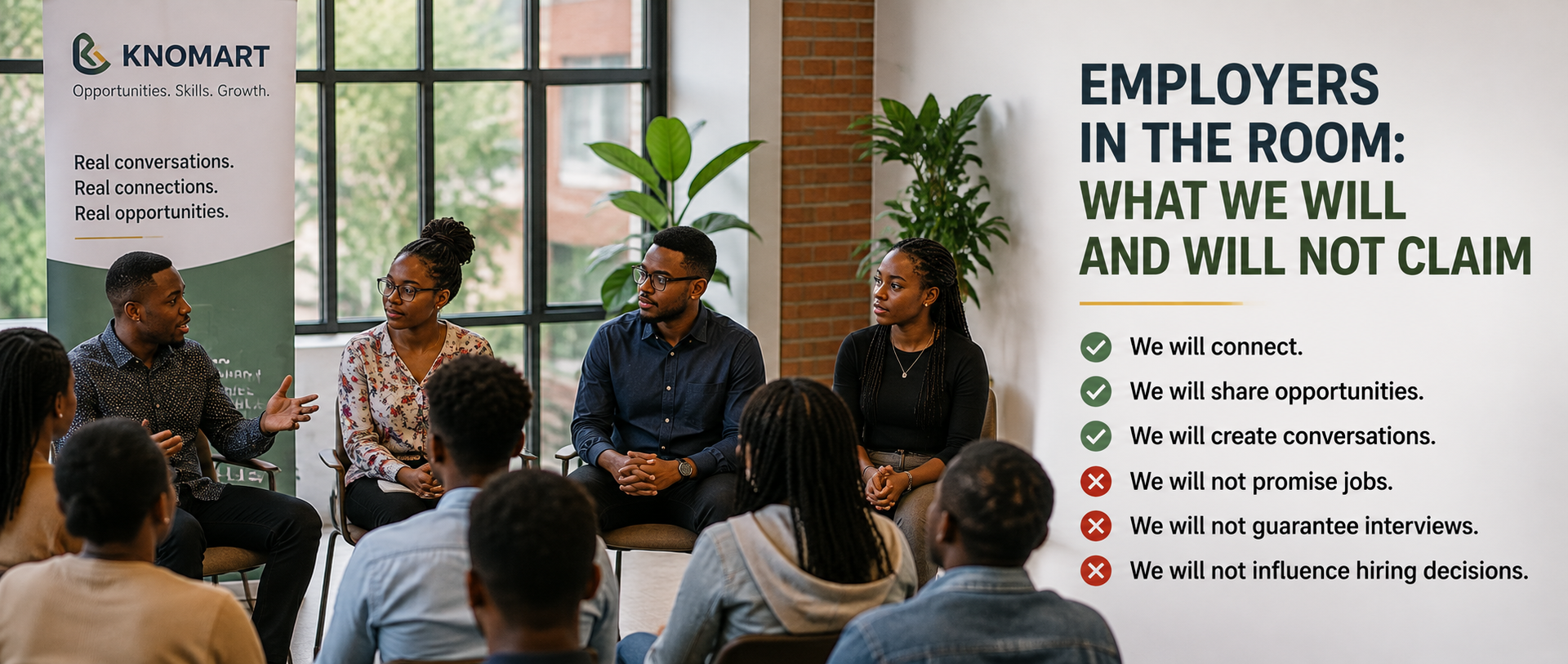
Employers in the Room: What We Will and Will Not Claim
Having an employer in a room can make a career conversation more practical.
A young person can hear what a business actually looks for, ask questions about work, understand expectations and learn how an industry operates.
But there is an important line between access to an employer conversation and a promise of employment.
What an Employer Can Add
An employer can bring a perspective that general career advice cannot always provide.
They can explain the skills that matter in their industry. They can describe the kinds of problems their teams solve. They can discuss professional expectations, workplace realities and the difference between learning something and being ready to use it.
A conversation like that can help a participant make better decisions about what to learn and how to prepare.
Being in the Room Is Not Being Hired
This distinction needs to be clear.
If an employer participates in a session, that does not automatically mean the participants will receive interviews, jobs, contracts or preferential treatment.
An employer may listen, answer questions, share information or explain what they look for. Any actual hiring decision remains the employer's decision.
The room can create access to information and conversation. It cannot manufacture a job.
What We Will Claim
The honest claim is simple: bringing employers into a useful conversation can give participants a better understanding of work and employer expectations.
That can be valuable even when nobody is hired as a result of the session.
A participant may discover that a skill needs strengthening. Another may realise that a particular career is not what they expected. Someone else may understand how to prepare more effectively for a future opportunity.
What We Will Not Claim
We should not say that an employer appearance guarantees a job.
We should not imply that attendance guarantees an interview.
We should not present participation as proof that an employer will recruit from the room.
And we should not turn a conversation into a marketing promise about outcomes that nobody in the room controls.
Why the Boundary Matters
Youth employment is important enough that programmes should be especially careful with expectations.
Someone looking for work may hear a promise differently from someone who is simply attending an event. A statement that sounds like “employers will be there” can easily become “there will be jobs for us.”
Good communication prevents that misunderstanding before it starts.
The Value Is Still Real
Removing exaggerated promises does not make an employer session less useful.
It makes the value more honest.
The participant gets a chance to listen, ask, learn and prepare. The employer gets a chance to explain the reality of work. The programme creates a structured conversation without pretending to control the final decision.
Bring employers into the room for what they can genuinely offer: knowledge, context and conversation. Never turn their presence into a promise of a job.